

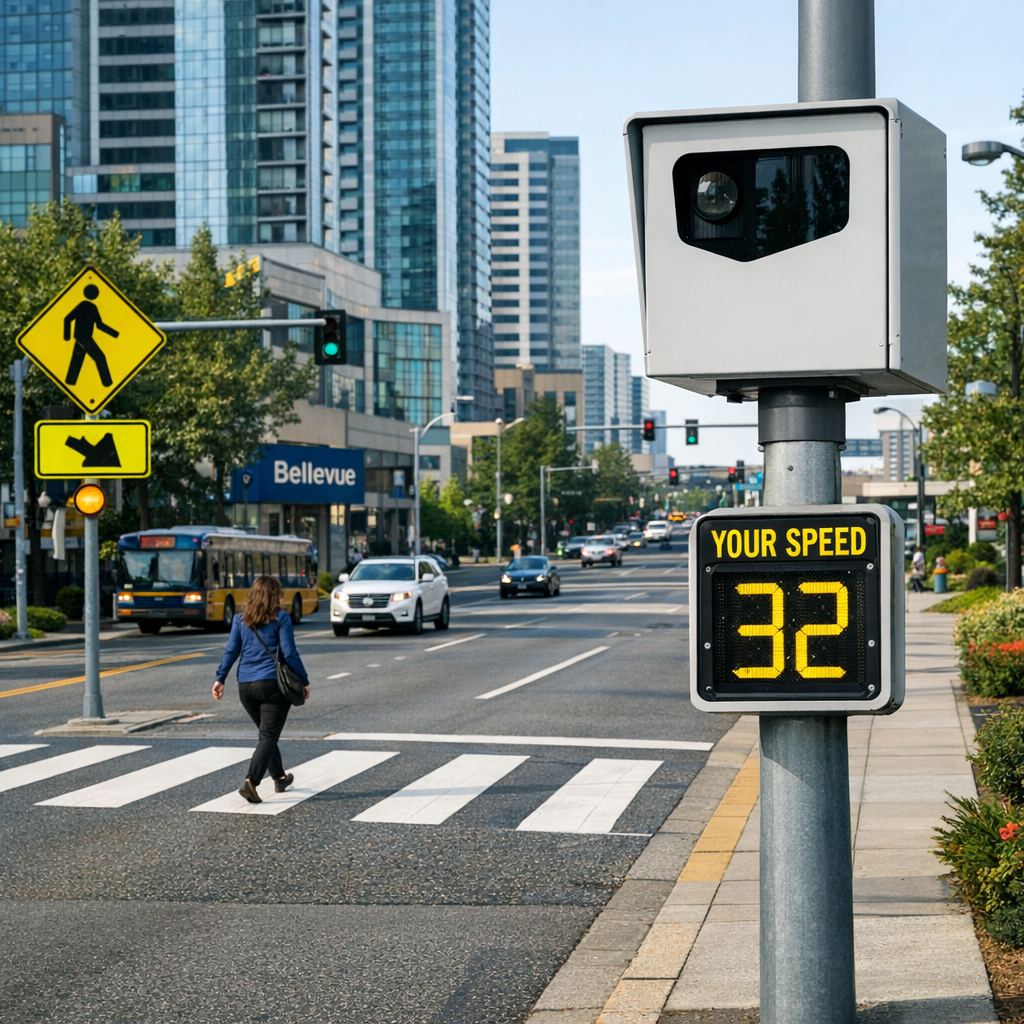
New Speed Safety Cameras for High-Risk Streets
The Bellevue City Council recently approved a plan to install speed safety cameras across seven locations as part of the city’s Vision Zero initiative. Targeted spots include areas near parks, hospitals, school walk zones, and corridors with a history of speed-related crashes. The goal is to reduce serious injuries and fatalities by keeping speeds in check. Cameras will first capture images in Summer 2026 after a warning period, with full citation enforcement to follow.
This is not Bellevue’s first push toward safer streets. Earlier reductions in speed limits along select roads resulted in measurable drops in dangerous high-speed driving (40 mph or higher). Public support has also been strong, particularly when speed reductions are paired with street design adjustments and enhanced enforcement.
Zoning, Signs & a Moratorium on Detention Center Uses
On zoning, the City Council adopted parts of an omnibus land use code amendment. Key changes include more flexibility in how affordable housing is counted (for example via fee-in-lieu rather than requiring on-site units in some areas) and adjusting tree credit rules in certain zones. While most councilmembers supported the package, there were concerns that some provisions weaken long-held land use policies.
Additionally, a revised sign code was unanimously approved to simplify rules in light of recent court decisions. Notable updates: temporary signs no longer need elaborate registration, yard signs on private property are mostly exempt, and signs in public spaces are allowed without registration if only posted briefly.
The city also enacted a one-year moratorium on permit applications for any new detention centers. This pause aims to give city staff time to study land use regulations related to detention facilities and determine if new policy limits are needed.
Human Services, Utilities, and Community Input
The 2025 Human Services Needs Update revealed gaps in resources like food, housing, and financial stability. Bellevue has around $6.5 million annually available across several funding streams for the coming years, and City Council is using the needs assessment to guide where those funds go. There’s also broad attention being paid to utility equity and assistance programs—especially for low-income residents, seniors, and veterans.
On the infrastructure front, Bellevue Utilities secured half-a-million dollars in federal funding to help with planning the Lake Washington sewer system, a vital project for public health and water quality. Some road closures and detours are expected during construction, but city officials are promising frequent updates and a transparent schedule for impacted neighborhoods.
How You Can Stay Involved
- Review maps of the High Injury Network streets and participate in Road Safety Assessments when they open—your input helps shape which improvements come first.
- Attend public forums or council meetings when zoning or land use changes are being discussed to share concerns or suggestions.
- If you or your neighbors face utility hardships or are veterans with high disability ratings, reach out about assistance programs—Bellevue is evaluating how to expand help.
- Watch for notifications on construction closures or detours so you can plan travel routes ahead.
Bellevue’s current city policies reflect a dual push: make streets safer today and plan land use and services more equitably for everyone. While not all decisions are unanimous or uncontroversial, the direction is toward collaboration and transparency.