

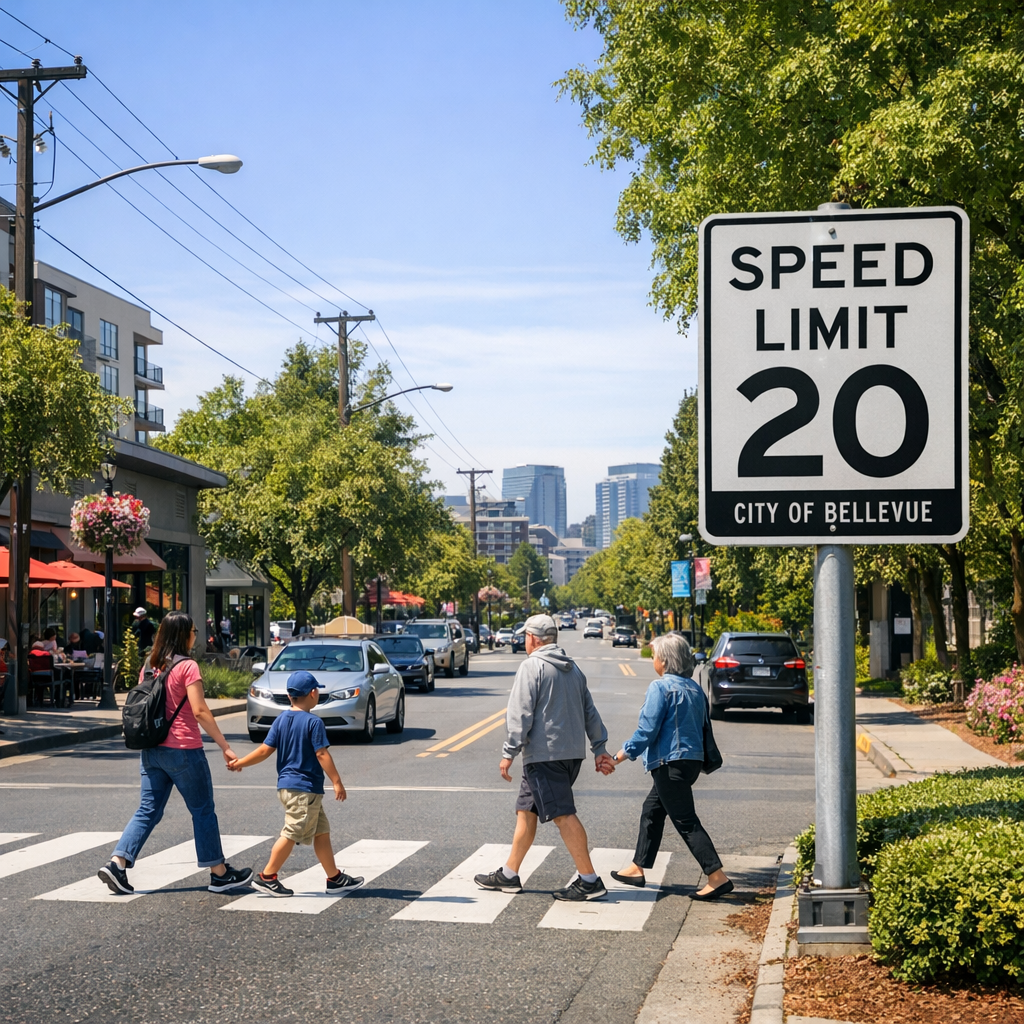
Earlier this summer, Bellevue city leaders put a significant change into motion: lowering speed limits on local or neighborhood streets from 25 mph to 20 mph. The new posted signs began going up August 24, bringing speed limits into effect immediately in North Bellevue — including areas like Lake Hills, Northeast Bellevue, Crossroads, Wilburton, Bridle Trails, and Northwest Bellevue — with other neighborhoods scheduled for later installations this year. No grace period is built in; compliance starts when the signs go up.
Why the change?
Residents have long voiced concerns about speeding and safety in quieter neighborhood streets. Bellevue has identified speeding as a top contributor to fatal and serious-injury collisions, particularly in residential areas. To address these risks, city staff are combining the speed-limit change with a suite of traffic calming tools: speed humps, radar feedback signs, speed safety cameras, and traffic circles. The aim is to reduce dangerous high-end speeding (drivers going significantly over the posted limit), make walking and rolling safer, and enhance predictability of speed limits across residential zones.
How it works and where
• Signage and markings: The plan covers installation of approximately 360 new 20-mph signs and about 190 pavement markings citywide. Around 325 existing signs will be replaced and about 35 will be entirely new.
• Early neighborhoods: The first wave includes North Bellevue neighborhoods (Lake Hills, Northeast Bellevue, Crossroads, etc.). Other neighborhoods will get their new signs later in the year.
• Supporting measures: Traffic calming projects are already underway along many corridors — think NE 28th Street between 164th Avenue NE and Ardmore Park, and 173rd Avenue NE, for example. These include new sidewalks, speed cushions, or reduced curb-to-curb widths where feasible.
What residents can expect
• Slower travel times: For short local trips, the difference should be modest. On neighborhood roads, dropping from 25 to 20 mph tends to add just seconds to each block.
• Improved safety and comfort: Especially for people walking, biking, schoolchildren, and older adults. The lower limit helps reduce both the likelihood and severity of crashes.
• Clear enforcement: New signage marks the change; speed safety cameras and radar feedback will help with compliance.
• Community involvement: Feedback gathered through recent surveys — including concerns from schools and parents — guided where and how changes are being prioritized. Several corridors were evaluated and ranked based on vehicle speeds, proximity to schools and parks, and neighborhood support.
How you can get involved or stay informed
• Watch for signs go up in your neighborhood. Once installed, the new 20 mph speed limit is in effect.
• Use Bellevue’s online tools to track traffic-safety projects and submit speeding or safety concerns in your area.
• Attend city council and transportation commission meetings — officials will report on the effectiveness of the change, along with progress on supporting infrastructure and whether further interventions are needed.
• Share your experiences. Personal observations about problem intersections, cut-through traffic, or speeding help guide city decisions.
Slower streets aren’t just about limits on paper — they’re about how Bellevue designs its roads, enforces safety, and listens to residents. This change reflects growing momentum toward safer, more walkable neighborhoods. As signs go up, the effects will become clearer: fewer high-speed drivers, safer crossings, and a quieter sense of community.